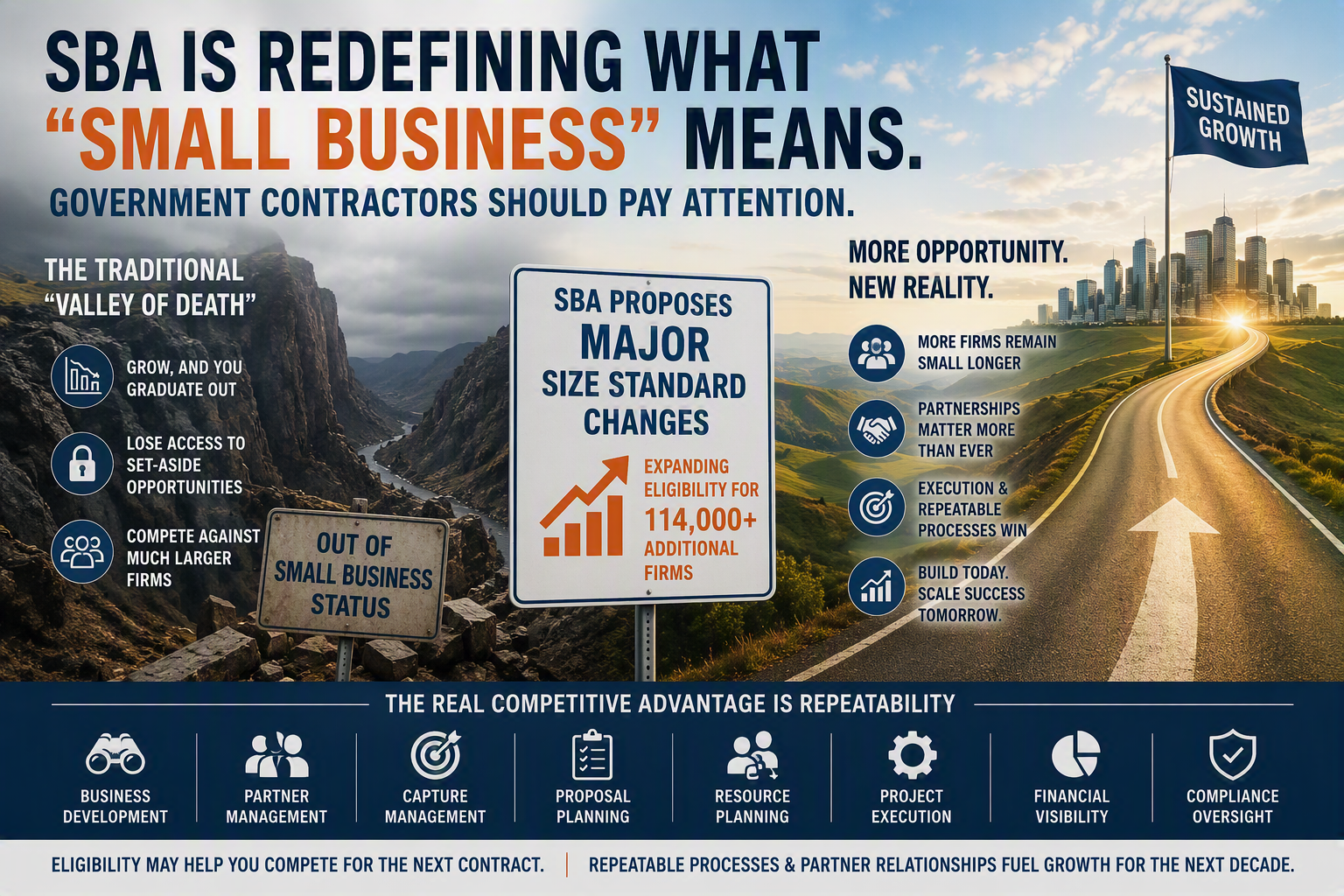
For years, government contractors have operated under a relatively stable understanding of what it means to be a small business. Growth was the goal, but eventually success came with a consequence: graduating out of small business status and into the challenging world of full and open competition. That framework may be changing. The SBA has proposed one of the most significant overhauls of small business size standards in decades, expanding eligibility for more than 110,000 additional firms and dramatically increasing many size thresholds across federal industries.
While much of the discussion has centered on who qualifies as small, the bigger question is what these changes mean for the future competitive landscape of government contracting.
The Traditional “Valley of Death” Problem
One of the most persistent challenges in GovCon has been the growth paradox.
A company wins its way into success through set-asides, expands its workforce, increases revenue, and graduates beyond its size standard. Overnight, it finds itself competing against organizations with significantly greater resources, mature infrastructures, and decades of market presence.
The SBA’s proposal appears designed to address that challenge by allowing successful firms to remain eligible for small business programs longer and continue scaling without immediately losing access to critical opportunities.
For many growing contractors, that could be a welcome change.
More Opportunity… Or More Competition?
Of course, every policy change creates both opportunities and concerns.
If larger and more established firms remain eligible for small business competitions longer, newer entrants may find themselves competing against organizations with sophisticated proposal shops, mature delivery teams, stronger balance sheets, and more established customer relationships.
Supporters argue the current thresholds often force companies out of small business programs too early. Critics argue the proposed thresholds could blur the line between truly small businesses and larger mid-market contractors. Both perspectives have merit.
The reality is that the definition of competitive advantage may be shifting.
Winning may become less about size classification and more about operational maturity.
The Biggest Impact May Not Be Eligibility
Most contractors immediately ask:
“Will I still qualify as a small business?”
It’s an important question, but it may not be the most important one.
As competition increases, the organizations that consistently win will be those that can execute better. They will be the firms that can move seamlessly from opportunity pursuit to contract award to project delivery without losing critical information or creating operational friction.
That means having repeatable processes around:
- Business Development
- Partner Identification & Relationship Management
- Capture Management
- Proposal Planning
- Resource Forecasting
- Labor Management
- Project Execution
- Financial Visibility
- Compliance Oversight
Because winning a contract is only the beginning.
The real challenge starts the moment the contract is awarded.
Earlier Importance of Building Partner Relationships
Most discussions around the proposed SBA changes have focused on eligibility. But for many truly small businesses, the more important question may be how they continue to compete if the pool of “small” contractors becomes larger and more sophisticated.
If firms with significantly more revenue, infrastructure, proposal resources, and delivery maturity remain eligible for small business opportunities, smaller contractors may need to rely more heavily on strategic partnerships to remain competitive.
That means building partner relationships earlier.
Too often, teaming discussions happen after an opportunity is identified and a proposal deadline is approaching. By that point, contractors are frequently trying to assemble teams, fill capability gaps, and establish relationships under pressure.
The firms that are most successful in this environment will likely be those that develop partner ecosystems long before an RFP is released. They will engage partners during business development and capture, not just during proposal development. They’ll understand who can support staffing needs, who brings complementary past performance, who can strengthen delivery capabilities, and who can help mitigate execution risk.
As competition evolves, the ability to build and manage repeatable winning teams may become just as important as the ability to win the opportunity itself.
Don’t Ignore The M&A Impact
Contractors should also be paying close attention to SBA recertification changes that have already taken effect.
Recent SBA rule changes create stricter requirements for recertification following mergers, acquisitions, and changes in ownership. For many contract vehicles, losing certain small business qualifications through a recertification event can impact future eligibility for task orders and options.
Combined with the proposed size standard changes, we could see a GovCon market where:
- More firms remain small longer
- More acquisitions occur within the small business ecosystem
- Set-aside competition becomes increasingly sophisticated
- Agencies gain access to larger pools of experienced contractors
The firms that prepare now will be in a much stronger position regardless of where the final rules land.
The Real Competitive Advantage Is Repeatability
Regardless of how the SBA ultimately redraws the boundaries of “small business,” one thing won’t change:
Government contractors still need to deliver.
The companies that consistently grow are rarely the ones with the best PowerPoint presentation or the most certifications on paper. They’re the ones that create repeatable processes that can be executed over and over again.
Every successful contractor has workflows behind their success:
- How opportunities move from BD to Capture
- How awarded work transitions into execution
- How labor is planned before performance starts
- How contract requirements flow into project management
- How leadership maintains visibility into delivery, staffing, and financial performance
When those workflows live across spreadsheets, inboxes, and disconnected systems, scale becomes difficult. Information gets lost between teams. Decisions slow down. Risk increases.
That’s where organizations can create a meaningful competitive advantage.
At BizBone, we believe the future belongs to contractors that operationalize their success. Not just winning a contract once, but building repeatable, winning workflows and partner ecosystems that can be duplicated across every opportunity, program, and customer.
The organizations that consistently grow are the ones that can connect business development, capture, teaming partners, project execution, workforce planning, compliance, and financial management into a single, repeatable process.
As the SBA evolves what it means to be a small business, contractors should be asking a different question:
Are we building an organization that can scale success repeatedly?
Because eligibility may help you compete for the next contract. But repeatable processes and repeatable partner relationships are what fuel growth for the next decade.